


For a while now, I’ve been struggling with the cost of automation.
By cost, I don’t mean the monetary cost. And by automation, I don’t just mean AI.
The cost I’m actually interested in is what we lose as individual human beings when we overly rely on automation—AI is a good current representation of automation.
To help me wrestle with this, I talked to my Dad about his time as a pilot.
**
In his 40+ year career, he experienced an automation revolution within the cockpit.
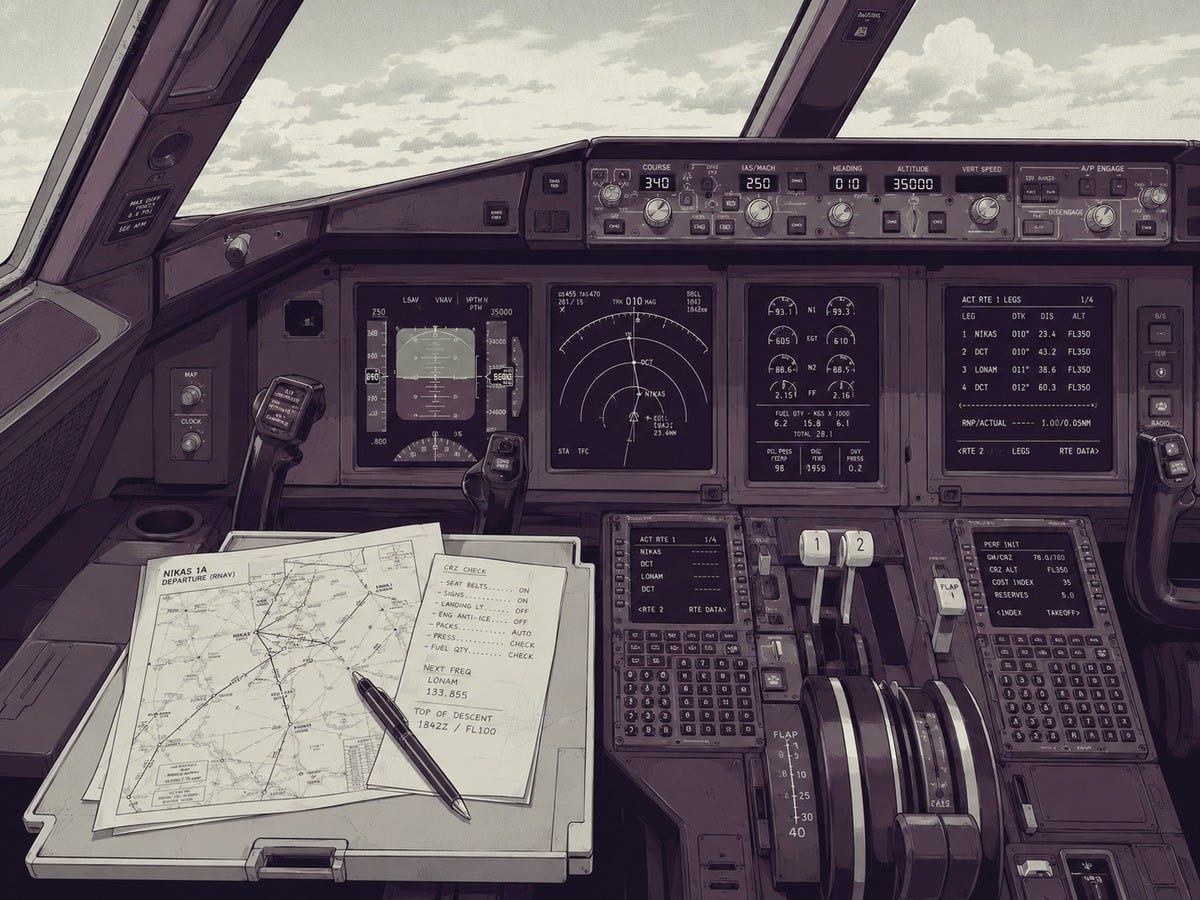
When he first sat in a cockpit, many things were done manually. Charts were printed out, data was manually interpreted, and buttons were manually pressed.
Over time, less buttons needed to be pressed, printouts became screens, and interpretations were simply delivered, not made.
One of the things he struggled with when working with junior pilots, was that he felt like they were being taught how to work a sophisticated computer as opposed to how to fly a plane.
I challenged him a little on this, because from the point-of-view of the passenger, what difference does it make whether the pilot is working a sophisticated computer or whether they are “flying a plane?” So long as I arrive at my destination safely, that’s all I really care about.
I’ll come back to this specific point later.
For the sake of simplicity, in the rest of this post I am going to refer to two pilots: One who grew up in the modern era, let’s call them automation-first, and one from an older generation, like my Dad, let’s call them manual-first.
The thing I really wanted to understand is what does a pilot lose (if anything) by being automation-first? So I asked my Dad to get specific and tell me how and when the difference of being automation-first vs. manual-first might matter in a flight.
**
He started by telling me that one of the things he was trained to do very early on, was to pay attention.
In situations of oncoming bad weather for example, there would be many indicators of that weather prior to it actually hitting. The thing was, those indicators didn’t just make themselves known to you. You had to pay attention to them, interpret them, and act on them accordingly. This was the manual-first approach.
The automation-first pilot doesn’t necessarily need to pay attention in this way, the computer pays attention to the indicators for them and then provides the interpretation.
The interesting thing my Dad told me was that even though a lot of this is automated, the old indicators are still there, and you can still pay attention to them.
Now we arrive at the heart of the issue: Since both methods (paying attention yourself or just letting the computer do it for you) achieve the same end (avoiding bad weather), what does the automation-first pilot lose by not learning to pay attention to the indicators?
After a lengthy conversation with my Dad about this, I believe the answer comes down to a single plural word:
Senses.
**
By necessity, the manual-first pilot was forced to learn how to use their senses in the cockpit. For example, they had to use their sense of sight to read certain indicators, and interpret them. They simply had no other option. Over time, this meant that their sense of sight became sharper.
The automation-first pilot on the other hand, can, if they so choose, outsource their senses.
The computer does the seeing for them.
But, like I asked earlier, if both the manual-first and automation-first pilot can get me to my destination safely, then why would having sharper senses matter?
This is actually the wrong question.
The right question is, when would having sharper senses matter?
**
Senses are like tools. They are tools we always carry with us. Like any tool, they can get blunt.
A computer is also a tool.
In flying, the large majority of the time, there will be no incident. No cause for concern. Most things will be routine. Flying is much safer than driving a car.
But what about in a crisis?
In a crisis, having the right tools matter a lot.
A computer, is just one tool.
Our senses, especially if they are sharp, are yet another—possibly invaluable—tool.
Sharper senses matter in a crisis.
**
The reality is, we’re not all pilots. Nor are we constantly facing crises.
And yet, each time we rely on automation, we are outsourcing our senses. We are dulling them.
This is what we lose. This is the cost of automation.
I say this as someone who uses automation a lot.
The large majority of the time, this won’t matter. When our lives feel routine, free from incident, and with no cause for concern.
But as you and I both know dear reader, there are certain moments in life that matter more than others.
Not all moments are equal.
These moments aren’t always crises, but they can be inflection points in our days or weeks.
The timing of these moments is hard to predict, but they will happen at some point.
My hope is that when these moments come, our senses will be sharp enough to face them.
This post was such a bait and switch...in the BEST way. This is about a lot more than learning to SEE, and it's about a lot more than a pilot story. This...I think...is the BIG thing that we (humans) need to be paying attention to, and that we (parents) need to be teaching our kids. Let's unpack this one even more...