When I was 14, I lived in Singapore and had a haircut that went wrong.
I was getting it cut at home, and my usual style back then was to use a No.1 clip all the way around, essentially giving me a whole head of short hair.
From what I recall on this particular day, the No.1 clip we used wasn’t quite short enough, so my stepmom decided to take the clip off and go with the bare trimmer for the first time.
She started on the back of my neck to get a feel for how short the bare trimmer cut, but then her hand accidentally slipped and trimmed off a one-inch square at the bottom-right-side of my head.
It looked like someone had decided to wax that part of my head for fun.
In that moment, we discovered that the bare trimmer was just too short to use on the rest of my head. It would not have been appropriate for me to sport that look in school at the time.
So, what do you do when you have a one-inch square bald patch on the bottom-right-side of your head, at 14? It was too low for a cap to cover, toques didn’t exist in Singapore, and using a square-shaped band-aid may have raised unnecessary questions.
A collective decision was made to colour the bald patch with black eyeliner.
Singapore is a very humid country. The next day some of my friends noticed that my head was dripping black liquid from behind. I tried to appear confused.
I wish haircuts had an undo button.
**
Website overhauls are something I’ve done a lot of in my career.
There’s a simple philosophy that very few people abide by when it comes to website overhauls.
Evolution not revolution.
Rather than going from your website looking like one thing today, to an entirely different thing tomorrow, this philosophy involves using data to identify specific elements or pages on your website and working to improve just those pieces. You will have a different looking website, but it might take a few months, rather than it changing seemingly overnight.
One of the major arguments for this approach is that people hate change. If you’re familiar with the way a website works today and it completely changes tomorrow, there is no easy undo button.
**
A lot of things work in this seemingly unidirectional way.
Most house plants die because they are overwatered.
When cooking, it’s easier to add salt than to take it away.
If a room is cool, adding layers is easy. If a room is hot, removing layers still may not help.
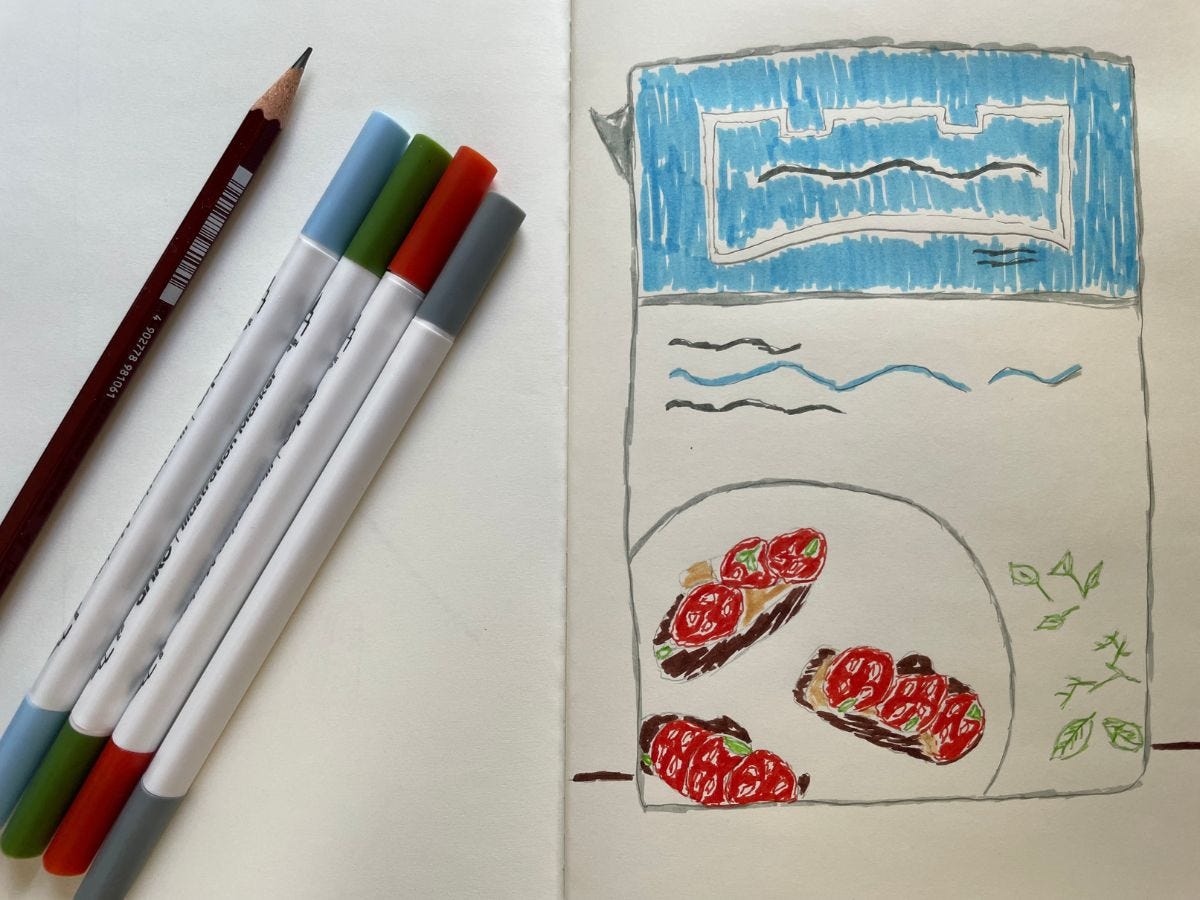
When I first started writing this post, I had a favourable position toward the undo button. Many parts of life would be made easier with one. While writing it, I took a break to draw the image that’s shown at the bottom of this post, and I realized something.
In my last post, I mentioned that I’ve made a decision to photograph or draw my images by hand moving forward. During the course of drawing the one below, I realized how badly I wanted an undo button.
The undo button is a beautiful way to hide our vulnerable parts. To remove our mistakes.
Sometimes, not having an undo button or even choosing against it, makes life more interesting.
It involves having to come up with some sort of explanation for what is actually black eyeliner dripping down the back of your neck. It involves sincerely apologizing to the good people at Windsor Salt, whose product I tried to illustrate below.
It involves making mistakes, because as Rick Rubin says, that’s where humanity breathes.